

When you visit my clinic, I often spend the first fifteen minutes talking about everything except your ears. We talk about the deep exhaustion you feel by late afternoon. We talk about why you have started skipping family dinners or why you feel anxious when the telephone rings.
As an audiologist and speech-language pathologist, I hear a familiar refrain from patients every single day: “My hearing isn’t perfect, but I manage just fine.”
But managing is not the same as thriving. What does life actually look like after treating hearing loss? It looks like a dramatic shift from isolation to active connection. Today, I want to show you exactly how a hearing aid bridges that gap and transforms your day-to-day experiences.

1. Eliminating the 4:00 PM “Listening Fatigue”
If you find yourself physically drained by the end of a social gathering, you are experiencing listening fatigue.
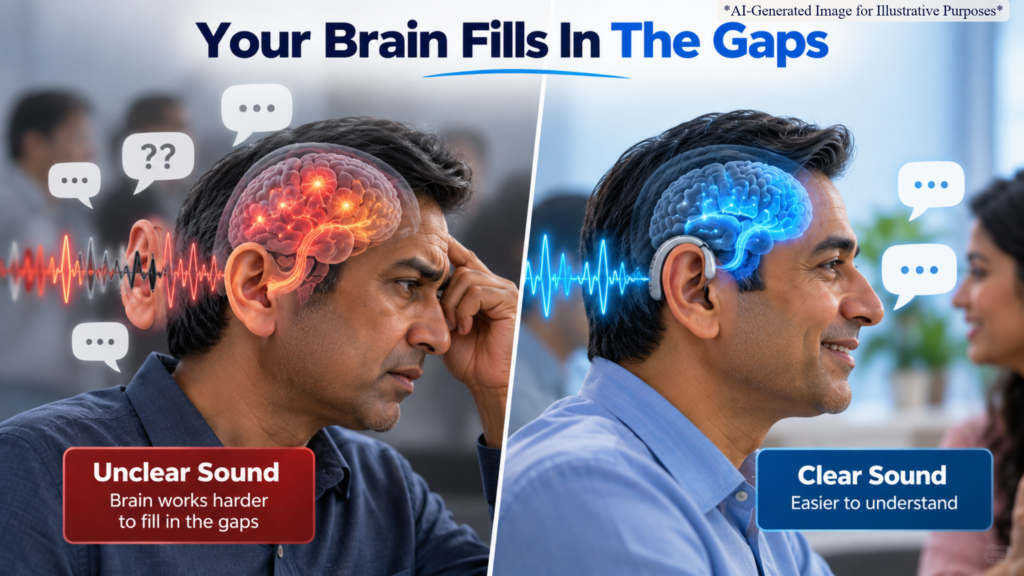
When you have healthy hearing, your brain processes sound effortlessly. But when you suffer from untreated hearing loss, the sound signals reaching your brain are blurry and full of gaps. To compensate, your prefrontal cortex—the area responsible for intense focus and working memory—must step in. Your brain essentially plays a non-stop game of guessing the missing words in every single sentence.
The Cognitive Tax: A study by the Danish Institute for Social Research found that 15% of workers with untreated hearing loss are so exhausted by the end of the day that they have zero energy left for family or hobbies.When I fit you with a modern hearing aid, we use advanced digital processing to isolate speech and clear up that blurry signal. By taking the heavy lifting off your brain, you instantly reclaim your late-afternoon energy.
2. Protecting Your Brain from Auditory Deprivation
Many commercial websites avoid this topic because it sounds alarming, but as your clinician, I believe you deserve absolute transparency: untreated hearing loss fundamentally alters your brain structure.
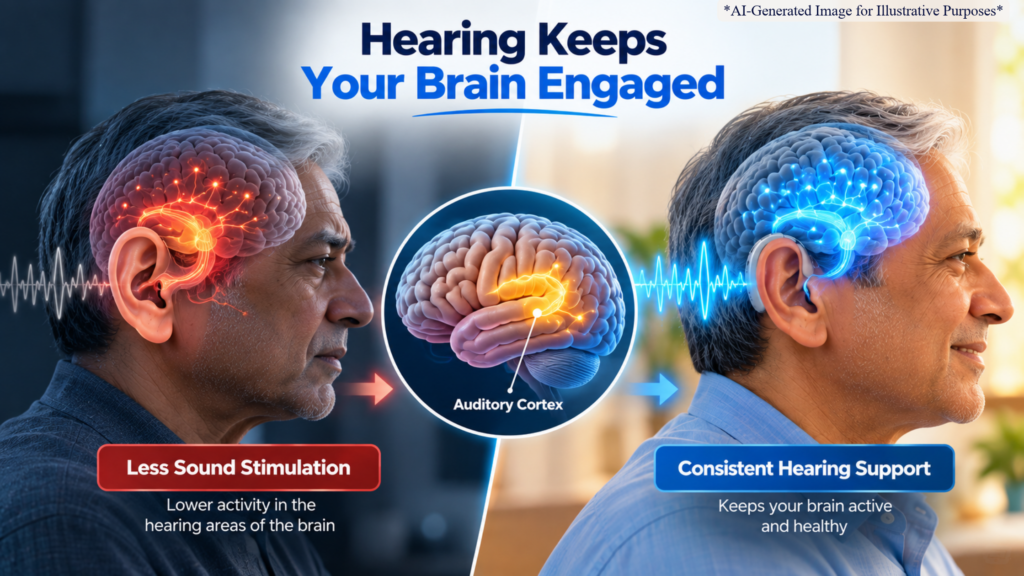
When your brain is starved of sound over months and years, it experiences a clinical phenomenon called auditory deprivation. Because the auditory cortex isn’t receiving regular electrical stimulation, the brain begins to reallocate its resources. In a literal sense, sections of the brain responsible for hearing can begin to shrink or atrophy from disuse.
We now know this has profound implications for long-term mental sharpness. The landmark Lancet Commission on Dementia identified mid-life hearing loss as the single largest modifiable risk factor for dementia, accounting for roughly 20.5% of overall modifiable risk.The good news is that we can actively counter this trajectory. The groundbreaking ACHIEVE Study, published in The Lancet, revealed that for older adults at higher risk for cognitive decline, managing hearing loss with hearing aids slowed down the loss of thinking and memory abilities by an astonishing 48% over a three-year period. Consistent amplification keeps your brain structurally active, healthy, and sharp.
3. Restoring Balance and Spatial Awareness
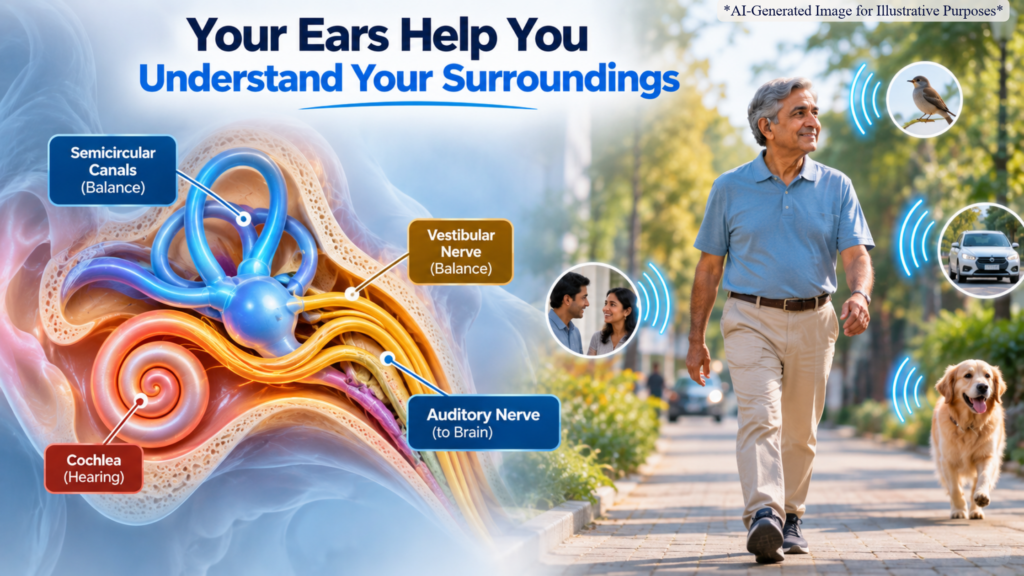
We rarely connect our ears to our feet, but your auditory system works hand-in-hand with your inner ear’s balance center to build a 360-degree map of your surroundings.
When your hearing drops, you lose your spatial orientation. You can no longer accurately judge the distance of an approaching vehicle or the sound of your own footsteps. Because your brain is completely consumed by the massive effort of trying to decode speech, it naturally compromises on the subconscious processing required for stability.According to researchers at Johns Hopkins Medicine, even a mild, untreated hearing loss triples your risk of experiencing an accidental fall. By restoring balanced, two-eared (binaural) hearing, I am able to give your brain its environmental awareness back, allowing you to walk confidently on any surface.

4. Healing the Invisible Fractures in Your Relationships
When I treat an individual’s hearing loss, I am usually treating an entire family. Hearing loss rarely impacts just one person; it ripples outward, causing a slow-burning frustration among spouses and children known as “repetition fatigue.”
When you miss the subtle, high-frequency vocal inflections that convey humor or warmth, you end up nodding along blindly to conversations you don’t actually hear. This is the exact moment where isolation begins, even when you are sitting in a room full of people who love you.
Hearing aids remove this friction entirely. They restore the effortless, split-second timing of a shared laugh at the dinner table. They allow you to answer the telephone without anxiety and bring an end to the domestic battle over the television volume.

The Power of a Proactive Choice
If you have been holding back because you worry about how a hearing aid looks, please remember: a tiny device sitting discreetly in the shadow of your ear is infinitely less noticeable than the constant requests to repeat a phrase, or the quiet withdrawal from a conversation.Getting your hearing evaluated isn’t about admitting a weakness. It is a proactive, powerful medical choice to protect your mental energy, preserve your long-term cognitive health, and stay profoundly connected to the people you love. If you notice that the world has sounded a bit more muffled lately, let’s schedule a comprehensive diagnostic evaluation together and give your brain the clear, vibrant support it deserves.
Frequently Asked Questions (FAQs)
1. How much do digital hearing aids cost in India, and are they covered by health insurance?
In India, digital hearing aids generally range from ₹10,000 to over ₹3,00,000 per ear, depending on advanced AI and Bluetooth features. Standard health insurance policies in India unfortunately do not cover them, though some corporate plans or premium packages may offer partial coverage or flexible EMI options.
2. Can I just buy a cheap sound amplifier online instead of a medical hearing aid?
I strongly advise against this. Cheap online amplifiers blindly increase all environmental noise, which can permanently damage your residual hearing. True hearing aids are sophisticated, miniature medical computers that I precisely program to amplify only the specific, deficient frequencies your unique brain needs.
3. How will a hearing aid help me follow family conversations in a loud Indian household?
Indian family gatherings are vibrantly noisy. Modern hearing aids use advanced digital signal processing and directional microphones to actively isolate immediate human speech while dampening chaotic background sounds. This allows you to smoothly follow dinner table conversations without feeling exhausted by the ambient noise.
4. Will wearing a hearing aid cure the constant ringing (tinnitus) in my ears?
While they do not cure tinnitus, they bring immense daily relief. By precisely amplifying the external environmental sounds you are currently missing, hearing aids naturally mask the internal ringing. This effectively trains your brain to focus on real world sounds rather than the internal noise.
5. Is there a completely invisible hearing aid available that hides my hearing loss?
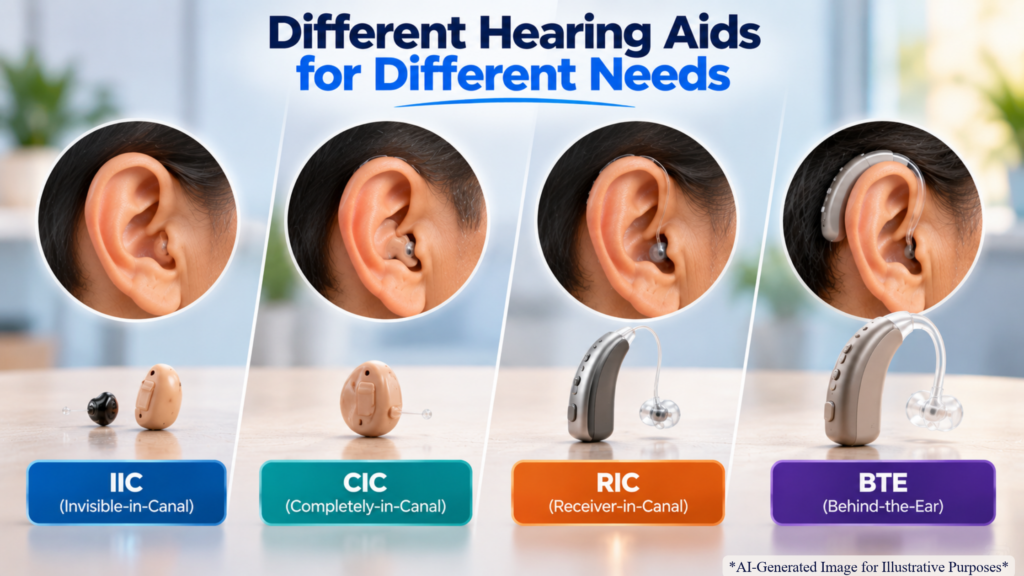
Yes, Completely-in-Canal (CIC) and Invisible-in-Canal (IIC) devices sit deeply inside your ear shadow, rendering them virtually invisible to others. During your diagnostic evaluation, I will assess your ear canal shape and level of loss to see if these highly discreet custom models suit your daily lifestyle.