
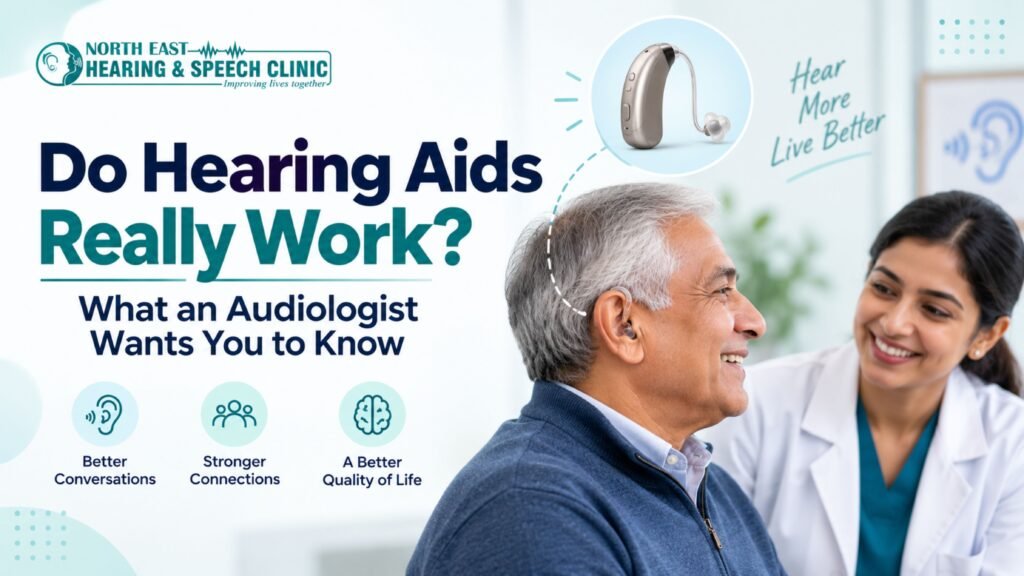
I hear it in my clinic almost every single week. A patient sits across from me, looks at the small digital devices in my hand, and asks with a mix of anxiety and skepticism: “But do they really work? My relative bought a pair, and they just sit in a drawer.”
It is a completely fair question. When you are considering investing your time, effort, and money into your health, you deserve an honest, clinically backed answer.
The short answer is yes, modern hearing aids work exceptionally well. However, as an audiologist and speech-language pathologist, I believe that answer lacks the critical nuance you actually need. Hearing aids do not work like reading glasses—you cannot simply slide them on and instantly achieve perfect, effortless results.
To understand how well they actually work—and how to make sure they work for you—we need to examine what happens between your ears, not just inside them.
Your Brain vs. Your Ears: How Hearing Aids Actually Work
When you lose your hearing, it is easy to assume the problem is entirely within your ears. In reality, while your ears collect sound, it is your brain that actually does the heavy lifting of listening and understanding.
When you live with untreated hearing loss—which people do for an average of 7 to 10 years before seeking help—the auditory cortex of your brain goes starving for stimulation. If a person breaks their leg and avoids walking for a year, their leg muscles will atrophy from disuse. Your brain functions the exact same way. When your ears stop sending clear sound signals, the neural pathways responsible for decoding speech begin to weaken. This medical phenomenon is known as auditory deprivation.
This is why buying a random, pre-programmed device online often leads to failure. If you throw maximum volume at a brain that has forgotten how to process sound, it will feel overwhelmed and exhausted. Hearing aids succeed because a professional can precisely program them to gently reintroduce specific missing sound frequencies, giving your brain the exact data it needs to rebuild those forgotten neural connections.
The True Measure of Success: Speech Clarity, Not Perfection
So, how well do they actually work? They work by restoring auditory clarity and reducing cognitive fatigue, not by giving you the ears of a teenager.
Modern digital devices do not just amplify every single sound in a room equally. They utilize advanced Digital Signal Processing (DSP) to sample your environment thousands of times per second. They automatically dampen predictable background noise—like the hum of an air conditioner or a busy restaurant crowd—while simultaneously sharpening the precise frequencies of human speech.
The data backing this up is profound. According to the landmark Lancet Commission report on dementia prevention, treating mid-life hearing loss is the single largest modifiable risk factor for preventing cognitive decline, accounting for roughly 8% of the global burden. Furthermore, major clinical research like the ACHIEVE Trial demonstrated that treating hearing loss with properly fitted hearing aids slowed down the loss of thinking and memory abilities by 48% over three years in older adults.
Why Do Some Devices Wind Up in a Drawer?
If the technology is so advanced, why do some people give up on them? In my clinical experience, it almost always comes down to skipping the acclimatization period.
When I first fit you with a prescription hearing aid, your brain is suddenly flooded with ambient environmental sounds you haven’t heard in years. The rustle of papers, the hum of a refrigerator, or footsteps—all of it will suddenly sound loud and unfamiliar.
This is a completely normal part of the process. A longitudinal trial published in the Journal of Speech, Language, and Hearing Research confirmed that while patients report high satisfaction early on, true long-term benefit and comfort stabilize steadily over a 24-week period of consistent use. Success requires patience and a structured wear schedule to let your brain adapt.
Additionally, true success depends on a clinical test called Real-Ear Measurement (REM). We place a tiny microphone inside your ear canal to measure exactly how much sound is hitting your eardrum in real-time. Without REM verification, setting up a hearing aid is essentially just an expensive guessing game.
My Professional Advice to You
If you or a loved one are noticing that you frequently ask people to repeat themselves, or that you are slowly withdrawing from social gatherings because it is simply too tiring to follow along, please don’t wait.
Hearing aids absolutely work—but they require a partnership. They need a precise clinical diagnosis, an expert custom fitting tailored to your unique anatomy, and a dedicated commitment to letting your brain adapt to the beautiful world of sound again. Protect your hearing, and in doing so, protect your brain health, your confidence, and your connection to the people you love.
Analyzing current healthcare digital marketing data in India reveals that patients approach hearing care with a distinct focus on affordability, local climate challenges, and long-term value.
The top five questions an Indian consumer asks regarding hearing aids center around overall cost, sweat/monsoon durability, hidden consultation fees, the necessity of buying a pair versus a single unit, and the availability of interest-free financing.
Here is the FAQ section tailored precisely to address these localized anxieties.
Frequently Asked Questions
Q1: How much does a quality hearing aid cost in India?
A single, basic digital device starts around ₹10,000 to ₹25,000.However, mid-range to advanced models featuring automatic noise suppression and clear speech-in-noise processing typically range from ₹30,000 to ₹1,50,000 per ear, depending entirely on the technology level your lifestyle requires.
Q2: Do I really need to buy a pair, or will one machine work?
If you have a medical loss in both ears, I strongly recommend a pair. Wearing two devices allows your brain to localize where sounds originate and improves speech clarity by up to 40% in noisy environments, preventing the untreated ear from losing its processing ability.
Q3: Can modern hearing aids survive the Indian summer and monsoon?
Yes, they absolutely can, provided you choose the right model. I routinely recommend devices with an IP68 rugged rating—such as the Phonak Audéo Lumity Life—which strictly shields the delicate internal digital circuitry against heavy sweat, accidental rain exposure, and ambient humidity.
Q4: Are there flexible monthly payment options available for patients?
Absolutely. I understand that premium hearing care is an investment, which is why my clinic collaborates with major medical finance groups like Bajaj Finserv to offer 0% interest EMI options over 6 to 12 months, making advanced prescription technology highly affordable.
Q5: Is the cost of the diagnostic test and tuning included in the price?
At my clinic, transparency is paramount. The initial precise diagnostic evaluation, custom programming via Real-Ear Measurement (REM), and your essential follow-up acclimatization adjustments during the first few months are completely bundled into the final price of your prescription device.
For a deeper dive into the exact diagnostic questions you should ask your specialist before making an investment, check out this video on Questions to Ask Before Buying Hearing Aids. It beautifully illustrates why the specific clinical testing protocols I use matter far more than the brand of hardware you choose.
Here are your search-optimized, click-worthy titles and meta descriptions, tailored precisely to address the deep-seated skepticism of a hesitant, first-time buyer while meeting strict SEO criteria